Our Top Picks
These are the ones worth your money out of what's easy to get hold of in the UK. All the links go to Amazon. As an Amazon Associate, we earn from qualifying purchases.
| Product | Type | Best For | Buy |
|---|---|---|---|
| SANSI 2-Head LED Grow Light, 20W | Two-head, 20W | Best Overall | Check price |
| Full-Spectrum LED Grow Light Strip | Shelf strip, adhesive | Best Budget | Check price |
| Wolezek Clip-On Grow Light, 3500K Full Spectrum | Clip-on + timer | Best With Timer | Check price |
| MICCYE Floor-Standing Plant Light, 25W | Floor stand, 25W | Best for Growing On | Check price |
SANSI 2-Head LED Grow Light, 20W
Two heads on goosenecks, full spectrum, 20W at the wall. Aimed at a single seed tray from about 20cm it does the job British daylight can't in February. Left on 16 hours a day it costs about 8p a day at the July 2026 price cap, so roughly £2.50 a month. The goosenecks let you raise the light as the seedlings grow, which is the whole game — too far away and they stretch, too close and they scorch.
- 20W, about £2.50 a month at 16h/day
- Two adjustable heads
- Reaches one full seed tray
Full-Spectrum LED Grow Light Strip
Nine quid. Stick it to the underside of a shelf and the shelf below becomes a seedling bench.
- Turns any shelf into a seedling bench
- Adhesive backing, no stand needed
- Weak on its own for anything past the seedling stage
Wolezek Clip-On Grow Light, 3500K Full Spectrum
Clamps onto a shelf edge, a windowsill or the side of a table, with a built-in timer so it runs its own 16 hours without you. The 3500K spectrum is warm enough to live with in a room you also sit in, which matters more than the spec sheets admit — the pink-purple lights are effective and horrible to share a house with.
- Built-in timer
- Clamps anywhere
- 3500K — bearable in a living room
MICCYE Floor-Standing Plant Light, 25W
A free-standing tripod rather than a clamp, for when there is no shelf edge to grip and no windowsill worth using. Height adjusts as the plants grow. It is the one to buy if you are growing on tomatoes and chillies indoors past the seedling stage rather than just germinating them.
- Free-standing — no shelf needed
- Adjusts up as plants grow
- 25W, about £3 a month at 16h/day
- Takes floor space
Why UK Seedlings Go Leggy
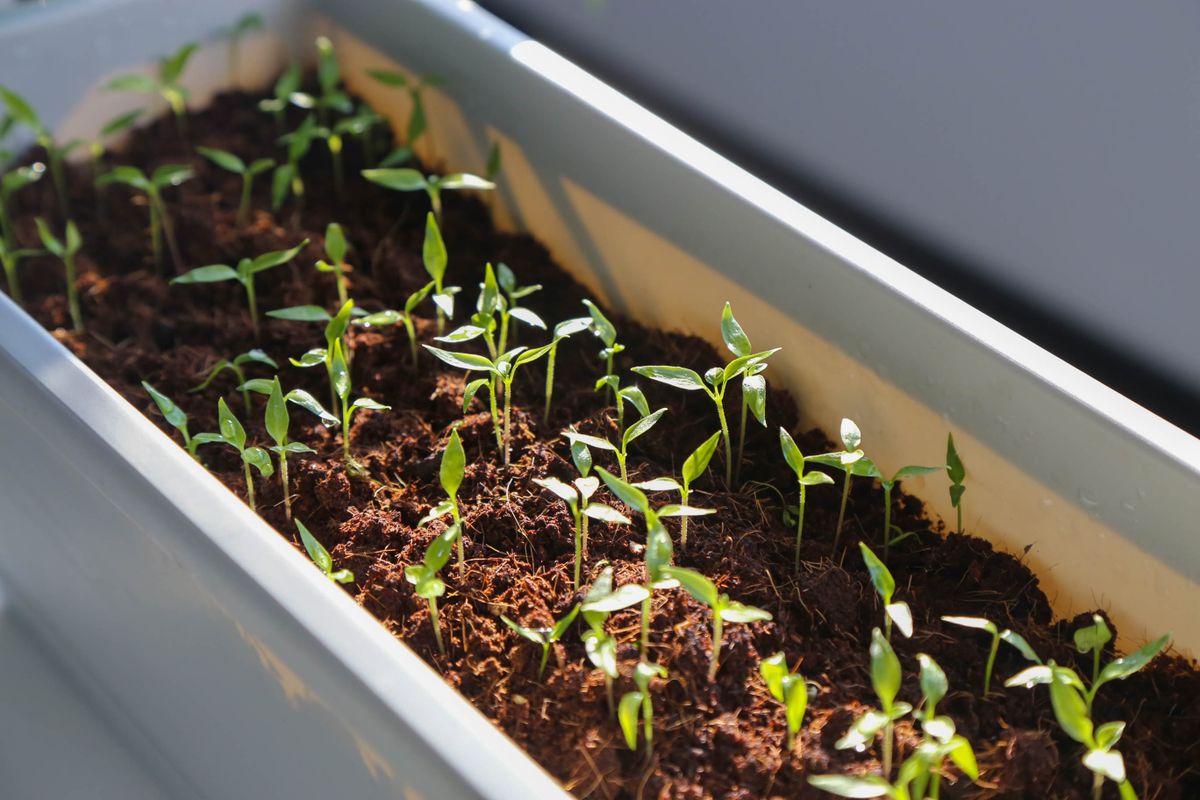
A seedling stretches towards light. If the light is weak it keeps stretching, and you get a long pale stem holding up two small leaves. That plant never fully recovers.
In January a British day is about eight hours long, and much of it is overcast. A windowsill also only lights the seedling from one side, so it leans. This is why February sowings on a windowsill so often fail even when germination was perfect — the propagator did its job and then nothing followed it.
A 20W LED over a seed tray fixes it. Not a houseplant lamp, not a desk light: something full spectrum, sat 20–30cm above the tray, running to a schedule.
How Long to Run Them
Fourteen to sixteen hours a day, then off. Seedlings do want darkness — running lights round the clock does not double growth and wastes electricity.
Put it on a timer, whether that is a built-in one or a £5 plug timer. Doing it by hand means the morning you leave the house early is the morning your seedlings get four hours.
How Close to Hang It
For a 20–25W LED over a seed tray, 20–30cm is about right. Then watch the plants rather than the tape measure. Stems stretching and leaning means raise the light output or lower the lamp. Leaves curling at the edges or going pale in the middle means it is too close.
Raise the lamp as the seedlings grow so the gap stays roughly constant. Goosenecks and adjustable stands exist for this reason; a strip screwed to the underside of a shelf has a fixed height, which is why it suits trays rather than growing-on.
What They Cost to Run
At the July 2026 Ofgem cap unit rate of 26.11p/kWh, running 16 hours a day:
| Light | Rated power | Per day | Per month |
|---|---|---|---|
| Shelf strip | 10W | 4p | £1.25 |
| Two-head LED | 20W | 8p | £2.51 |
| Floor-standing LED | 25W | 10p | £3.13 |
Watch the wattage claims. A light sold as "300W equivalent" may draw 20W. The equivalent figure is marketing; the number you pay for is the real draw, which is usually buried in the specification. If you want to know for certain, a plug-in energy monitor settles it for £12.
Building a Seedling Shelf
The cheapest useful setup in a UK house is a four-shelf steel rack from a DIY shed and a light strip stuck to the underside of each shelf. Three strips is under £30 of lighting and gives you three levels of seed trays in a spare room or a hallway.
Add a heat mat on the bottom level for the chillies and you have covered germination and growing-on for less than the price of a cold frame. If the whole thing needs to be light-tight and warm, that is when a grow tent starts to make sense.
Common Questions
Do seedlings really need a grow light in the UK?
From about mid-February onwards, on a bright south-facing sill, you can get away without one. Anything sown in January or early February, or on a north-facing window, will stretch. The tell is a stem longer than the seedling is wide.
How many hours a day should a grow light be on for seedlings?
Fourteen to sixteen. Use a timer. Twenty-four hours does not help and costs half as much again.
How much do grow lights cost to run?
A 20W LED on 16 hours a day costs about 8p a day, or £2.51 a month, at the July 2026 cap rate of 26.11p per kWh.
Can I use a normal LED bulb instead?
Poorly. Household bulbs are tuned for how a room looks to your eye, not for the red and blue a plant uses, and they are usually far too dim at the distance you would hang them. A £9 strip beats a £9 bulb comfortably for this job.
How close should a grow light be to seedlings?
20–30cm for a 20–25W LED. Raise it as they grow. Stretching stems mean too far; pale or curling leaves mean too close.
Do I need a purple light?
No. Full-spectrum white LEDs work as well for seedlings and are far easier to live with in a room you use. The pink-purple ones are not more effective, they are just cheaper to make.